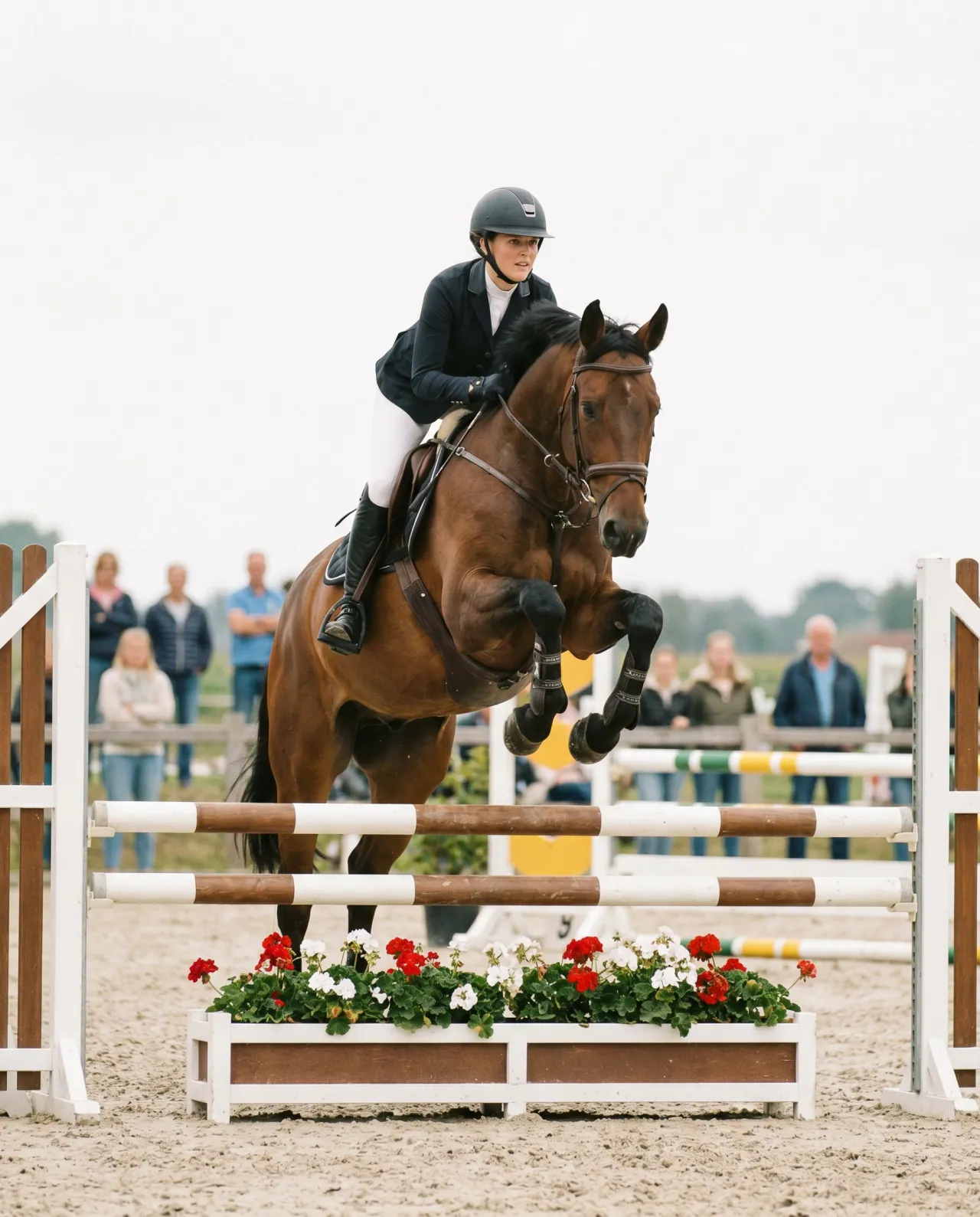
Level 3 · First competitions
Ready for the show ring?
You have your own horse and want to start competing. The route from applying for a startpas to your first show: choosing a discipline, choosing a class, and what to bring on the day itself.
74 guides in English
What to read here.
Heat Stress in Horses: Recognizing, Cooling, and Preventing It
How to recognize heat stress in your horse, why plenty of cold water is the best first aid, and how to plan hot days around riding, turnout, and transport.5 min readMares in Heat: Normal Behavior and When It's Something More
What being in heat means for mares, what behavior is normal during the cycle, how to handle it in training and competition, and when to call the vet.6 min readToo Fat or Too Thin: Assessing and Adjusting Your Horse's Weight
How to use the body condition score and a weigh tape to judge whether your horse is too fat or too thin, and adjust its weight gradually.6 min readCaring for a Senior Horse: Cushing's Disease, Weight, and Adjusted Care
What changes as your horse ages: from coat and weight issues to Cushing's disease (PPID), dental care, and an adjusted care routine.5 min readColic in Horses: Recognizing Symptoms and What to Do Right Away
Recognize colic from your horse's behavior, know the types of colic, judge how serious it is, and know what to do right away and when to call.10 min read
Show all 26
Common Skin Problems in Horses: From Rain Rot to Sarcoids
Bald patches, scabs, and lumps: how to tell common horse skin problems apart and know when to call the vet.6 min readDeworming Horses: When, How Often, and Why Fecal Egg Counts Are Smarter
When and how often to deworm a horse, why fecal egg counts are replacing fixed schedules, and how to prevent resistance.6 min readRecognizing Eye and Ear Problems in Horses
A watery or squinting eye, or a horse shaking its head: how to read the signals, what to do yourself, and when to call the vet.5 min readYour Horse's Teeth: Dental Checks, Floating, and Warning Signs
How often to have your horse's teeth checked, what floating involves, and which eating or bit problems point to a dental issue.5 min readHorse First Aid: Building a Kit and Treating Wounds
What belongs in a first aid kit for your horse, and how to assess, clean, and bandage a wound until the vet arrives.5 min readLeg Protection for Horses: Tendon Boots, Fetlock Boots, and Bandages
When your horse needs leg protection, which type serves which purpose, and why fitting it wrong can do more harm than good.5 min readHorse Supplements: What Actually Works
When a supplement is worth it and when it isn't: joint supplements, electrolytes, and the rest, with a clear-eyed look at the claims.6 min readHorse Vaccination Schedule: Shots, Timing, and KNHS Rules
Which vaccinations your horse needs, how often to repeat them, and the influenza requirement the KNHS sets for competing.5 min readHow Much to Feed Your Horse: Hay, Concentrate Feed, and Daily Amounts
How much hay, concentrate feed, and water a horse needs per day, worked out from its weight and the work it does.4 min readLameness in Horses: Finding the Sore Leg and When to Call the Vet
How to recognize an irregular gait, locate the sore leg, judge how serious it is, and know when to call the vet right away.6 min readLaminitis in Horses: Causes, First Aid, and Prevention
How to recognize laminitis in horses, what to do during an acute attack, and how to reduce the risk in spring.6 min readMud Fever in Horses: Treating and Preventing Those Stubborn Scabs
Mud fever causes scabs and swollen lower legs that are easy to spot but slow to clear. Here's how to treat it and stop it coming back.4 min readWorm-Free Pasture: Pasture Management to Reduce Parasite Load
How manure removal, pasture rotation, and targeted deworming keep parasite pressure low on your pasture, without deworming more than necessary.5 min readRespiratory Problems in Horses: Coughing, Heaves, and Stable Dust
What coughing and labored breathing can mean, which signs to take seriously, and how to reduce dust in the stable.5 min readRiding Safety: Helmets, Body Protectors, and Airbag Vests
When a riding helmet is mandatory (law, KNHS, SVP), which standards apply to helmets and body protectors, and when an airbag vest is worth it.6 min readSaddle Fit Explained
How to tell if your saddle fits, which signals point to a poor fit, and when to call in a saddle fitter or vet.5 min readSeasonal Coat Care for Horses: Clipping, Blankets, and Shedding
When to clip a horse, when a blanket is needed, and how to adjust seasonal care for coat, sweat, and weather.5 min readStable Management and Hygiene: A Healthy Environment for Your Horse
How to set up a healthy horse stable: bedding, ventilation, mucking out and hygiene that protect the airways, hooves and skin.5 min readSweet Itch in Horses Explained: Managing the Itch Through Summer
What sweet itch is, how to recognize it, and how to manage the itch with rugs, shelter, and skin care through summer.5 min readTendon Injuries in Horses: Recognizing, Cooling, and the Long Road to Recovery
How to recognize a thickened tendon or warm leg after exercise, what to do right away, and why recovering from a tendon injury takes so much patience.6 min readWhen to Call the Vet: Urgency Levels, Emergencies, and Visit Costs
How to judge whether your horse's complaint can wait or is an emergency, what to report by phone, and what a vet visit costs.5 min read
Competition License in Belgium: How to Start with Paardensport Vlaanderen
Which licenses Paardensport Vlaanderen offers, what they cost in 2026, and how to apply for a competition license (Dutch: startkaart) through your club.5 min readTransporting a Horse in Hot Weather: The Rules and What Changes in 2027
How hot can it be when you transport a horse? The current limit, the new 30-degree limit from 1 April 2027, and tips to prevent heat stress.4 min readTransporting Your Own Horse: What You Need as a Private Individual
Do you need to register to transport your own horse? Usually not. What's required, when it counts as 'commercial,' and what to bring. For NL and BE.5 min readHow to Avoid Disqualification and Elimination at a Competition
The practical pitfalls that get dressage and show jumping riders eliminated, and how to avoid them on a normal competition day.5 min readCompeting in Belgium Explained: KBRSF and Paardensport Vlaanderen
How the Belgian competition system works (KBRSF, Paardensport Vlaanderen, and the LEWB) and what a Dutch rider must arrange to start.6 min read
Show all 19
Competition Dress and Tack Rules: What's Required, Allowed, and Banned
What you and your horse must wear at a KNHS competition: clothing, bridle, bit, spurs, and whip by discipline and class.5 min readBoarding Your Horse With Someone Else: The Boarding Contract
What belongs in a boarding contract for a horse at a boarding yard, and how liability is divided between the owner and the yard operator.6 min readHorse Lease and Co-Riding Contracts: What to Put in Writing
How to put a co-riding, half-board, or lease arrangement for your horse in writing: who pays what, who's liable, and what the contract covers.5 min readHorse Owner Liability: Who Pays When Your Horse Causes Damage
How liability for damage caused by your horse works in the Netherlands, when you're on the hook, and which insurance covers it.5 min readThe Horse Passport: Requirements and Microchip Explained
Which registration is legally required for your horse, how the microchip works, and what the food-chain page in the passport means.5 min readBuying a Horse: The Purchase Contract and Your Rights
What to put in a purchase contract and what protection you have against hidden defects: the difference between buying privately and buying from a dealer.5 min readEntering a KNHS Competition: How and Where
How to enter a KNHS competition: find the show, choose the right section, register, pay, and withdraw on time if needed.5 min readKNHS Membership, Startpas and Startlicentie: The Difference
Membership, startpas (also called startbewijs), and startlicentie: what the KNHS actually recognizes, what belongs to whom, and what you need to compete.5 min readHow KNHS Promotion Points (Winstpunten) Work
How the KNHS points system works: how you earn winstpunten (promotion points), how many you need, and when you're promoted to the next class.4 min readApplying for a KNHS Startpas: Step by Step
What you need for your first KNHS competition: membership, a registered horse, and the startpas (or startbewijs), with 2026 rates and lighter ways to begin.8 min readRiding Safely on Public Roads With Your Horse
Which traffic rules and gear apply when you take your horse on public roads, and how to approach a trail ride safely.5 min readStable Fire Safety: Prevention and Preparedness
How to limit a horse stable's fire risk: from hay storage and electrical wiring to an evacuation plan that holds up under pressure.6 min readDriver's License and Weight: Are You Allowed to Tow This Trailer?
Which driver's license you need to tow a horse trailer, how to calculate the permitted weight, and where the category B limit lies.6 min readUnwritten Rules at Horse Shows
The unwritten social codes at a horse show: how to behave in the warm-up arena, at the ring, and around judges and volunteers.5 min read
Horseback Riding With a Disability: An Overview of the Options
What's possible in equestrian sport for riders with a disability: from a trial lesson at an adapted riding school to para dressage and carriage driving.5 min readPara-Dressage: Competitive Sport for Riders With a Disability
What para-dressage is, how classification into five grades keeps the sport fair, which aids are allowed, and how to get started.6 min readRiding a Dressage Musical Freestyle: From Music Choice to Floor Plan
What a musical freestyle is, how to choose music that fits your horse's gaits, and how to build a floor plan that scores well.6 min readCavaletti and Gymnastic Jumping: Building Strength and Balance
How to train strength, rhythm, and jumping technique with poles and grid exercises, with guideline distances for walk, trot, and canter.6 min readRiding Transitions: Why They Work and How to Train Them
Why transitions between and within the gaits train balance, hindquarters, and attention all at once, and how to ride them better step by step.5 min read
Show all 18
Belgian Competition Classes Explained: How the Flemish System Works
How Paardensport Vlaanderen ranks dressage and show jumping into levels, how promotion works, and how it differs from the Dutch B-to-ZZ ladder.5 min readCommon Mistakes in a Dressage Test and How to Avoid Them
The mistakes that most often cost points in a dressage test (from imprecise riding to the letter to too little collection), each with a fix.5 min readDressage Arena Letters and Figures Explained
The letters around the dressage arena and the basic school figures explained, from the volte to changing rein.5 min readGetting Started With Eventing: From First Steps to the Cross-Country
How to get started with eventing in the Netherlands or Belgium: what it demands, and how to build up cross-country safely.5 min readWorking Equitation: An Introduction to the Discipline
What working equitation is, where the discipline comes from, and what a competition involves: an introduction to a lesser-known discipline.5 min readLearning Carriage Driving: Harnessing Up and Your First Competition
Learning carriage driving: lessons, the SRR Menbewijs, and what the KNHS rules require for your first competition, such as minimum age and helmets.7 min readShow Jumping Jump-Off Strategy: Choosing Lines and Pacing for Time
How to shorten lines, cut corners, and pace your canter in a jump-off to gain time without losing your clear round.5 min readWarming Up for a Competition: Dressage and Show Jumping
How to use the warm-up area to get your horse supple, alert, and on the aids into the ring, for dressage and show jumping separately.5 min readShow Jumping, Dressage, or Eventing: Which Discipline Fits You
The differences between show jumping, dressage, and eventing: what each discipline asks of you and your horse, and how to choose.5 min readDutch Competition Classes Explained: Which One Should You Start In?
How the KNHS class system works and which class you ride your first competition in: a low height class in show jumping, class B in dressage.4 min readHorse Show Packing Checklist: What to Bring
A complete checklist for your first show (paperwork, clothing, horse gear, and food), so you forget nothing on the day.5 min readOutdoor vs. Indoor: How the Competition Season Works
What outdoor and indoor mean in equestrian sport, and how the competition year moves from summer to winter season.5 min readPlanning Your Competition Season and Building Points
How to structure a competition year to earn promotion points and move up a class at a steady, sustainable pace.5 min read
Insuring a Horse Trailer or Truck: How the Coverage Works
How to insure a horse trailer or truck: what the car's liability covers, when hull coverage makes sense, and how the horse is covered en route.5 min readBuilding a Stable Floor and Riding Arena That Actually Work
How to build or improve a riding arena and stable floor: layers, materials, drainage, and realistic costs for a surface that lasts for years.6 min readWhat a Competition Day Costs: Entry Fees to Transport
What a competition day in equestrian sport costs (entry fees, transport, fuel, and incidental costs) and what that adds to your monthly horse budget.5 min readVAT Rules for the Horse Sector: How It Works
Which VAT rate and scheme apply to boarding, teaching, and horse trading: the outline for anyone starting a stable or business.5 min readBuying or Renting a Horse Trailer: What to Check
Which type of horse trailer suits you, what buying versus renting costs, and what to check when buying: from the floor and brakes to inspection and insurance.6 min read
Horse Podcasts: Dutch and English-Language Shows by Topic
An overview of horse and equestrian podcasts: Dutch and English-language shows on welfare, training, mindset, and news, and how to choose.6 min readChoosing the Right Horse Bit: Types and How They Work
Which bit suits your horse? An overview of the common types, how they act on the mouth, and how to arrive at the right choice.5 min readLoading and Transporting Your Horse Safely
How to load your horse into a trailer calmly and without stress, transport it safely to a lesson or show, and prevent loading problems.5 min readReading and Riding Your First Dressage Test
How a dressage test is structured, how to memorize it, and what to expect on the day of your first start.6 min readYour First Show Jumping Course: Course Walk, Lines, and Distances
For your first jumping class: how to walk the course on foot, learn the route, count distances in canter strides, and choose wide lines.4 min read
What everyone asks.
Which KNHS class do I start in?+
Beginner class B (jumping) or L (dressage) are the entry classes for leisure riders with their own horse. You move up based on promotion points earned, not on age or a self-chosen level.
How do I apply for a KNHS startpas (competition pass)?+
You need a KNHS membership (2026: €33.25 per year) and a registered horse. You then apply via MijnKNHS for one startpas for the combination of you and your horse; it covers dressage, show jumping and eventing (driving, endurance and vaulting use a separate startlicentie). A first 12-month pass costs €152 (pony €117); day and month passes exist too. In everyday Dutch the startpas is often called a 'startbewijs'.
What do I bring to my first show?+
Proof of your startpas, horse passport, proof of your own insurance, and your entry confirmation. Practical: bucket + water, hay, electrolytes, a clean set of tack, a spare saddle pad, helmet + body protector, and clothes for both the ring (white and black) and the stable (regular work clothes). Eat beforehand: show days run long.
Can I also compete in Belgium with my KNHS class?+
Not automatically. Belgium has its own federation structure (the KBRSF as the umbrella, with Paardensport Vlaanderen and the LEWB as regional wings) with its own licenses and its own class system. Your Dutch class doesn't carry over one-to-one, and for national Belgian competitions the federation usually requires an affiliation or admission. The guide on competing in Belgium lays out the whole route.
Amounts shown are indicative: actual rates differ per provider, region and season.
Next step · Level 4
On to
competing more seriously.
You compete regularly and want to get more serious. What separates riders who move up from those who plateau: training planning, equipment choices, mental preparation, and which instructor or national coach takes you further.
What awaits at level 4
- How do I build a training week that works?
- When does it make sense to move up a class?
- Which instructor fits this level?
- Which equipment makes a difference, and which doesn't?